
Water, the leading cause of construction disorders
Groundwater can cause major disorders to buildings and civil-engineering structures, both during construction and in service. The finding is unequivocal: 70 % of the disorders observed in buildings are caused by water, half of which result from insufficient or defective waterproofing, or even from the complete absence of drainage.
Detecting water when investigating a site to be built on is crucial: it governs the construction approach and the cost of the operation. Water can considerably alter the mechanical properties of certain soils and affect the stability of a slope or of a structure's bearing layer.
Water reservoirs on Earth
Across the whole hydrosphere, the oceans hold the overwhelming majority of water; groundwater comes third, behind the oceans and the glaciers. The table below gives an overview of water reservoirs and their residence time (the average time a water molecule stays there).
| Reservoir | Volume (1015 m³) | % of total | Residence time |
|---|---|---|---|
| Oceans | 1,350 | 97.0 | 2,500 years |
| Glaciers | 33 | 2.4 | 1,000 to 10,000 years |
| Groundwater | 8 | 0.6 | 1,500 years |
| Lakes | 0.1 | < 0.01 | 17 years |
| Water in the soil | 0.070 | < 0.01 | 1 year |
| Water in the atmosphere | 0.013 | < 0.001 | 8 days |
| Rivers | 0.0017 | 0.0001 | 16 days |
| Water in living matter | 0.0011 | 0.0001 | a few hours |
| Total | 1,391 | 100 | — |
The short residence time of water in the soil (about 1 year) reflects its role as a dynamic interface between the atmosphere, the deep aquifers and watercourses: it is a compartment that renews itself quickly, which explains its sensitivity to rainfall and droughts.
The forms of water in the ground
At the macroscopic scale
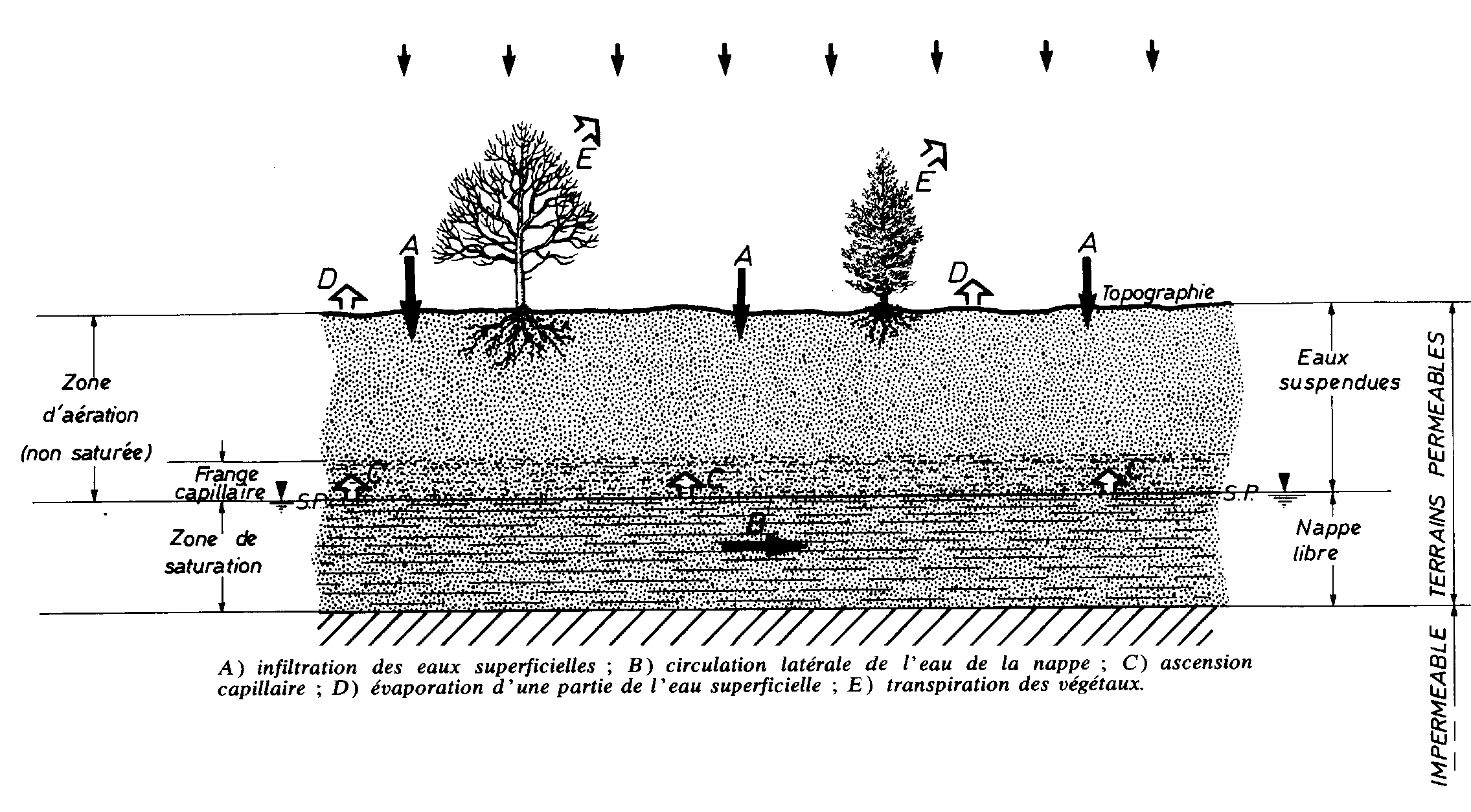
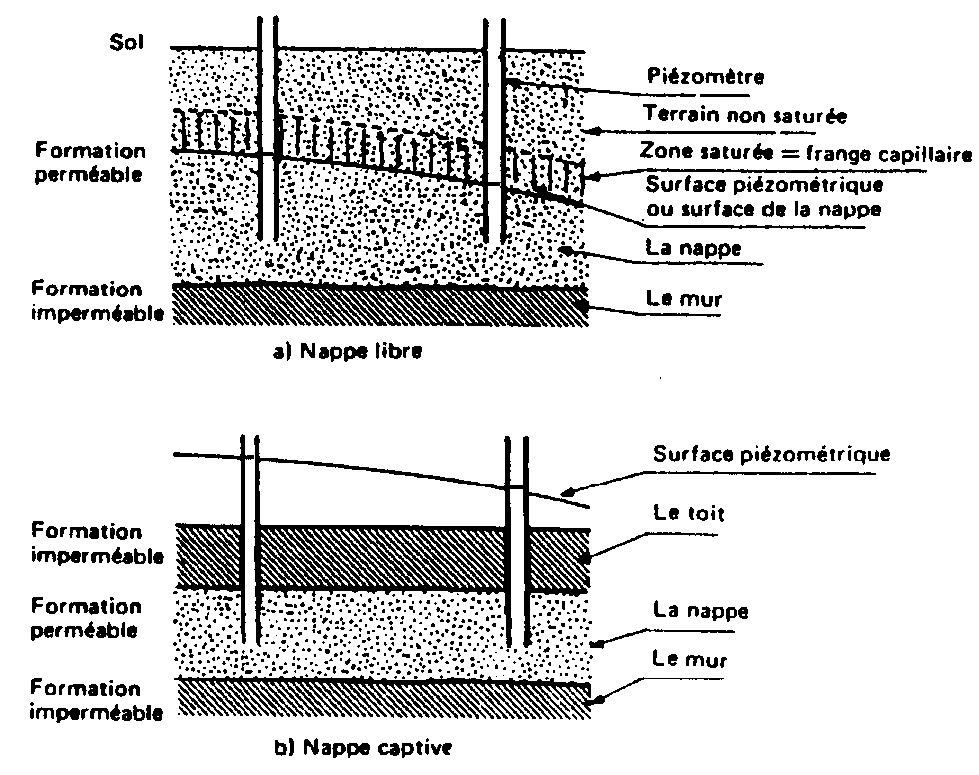
Several forms of water are distinguished in the ground according to their location and mobility:
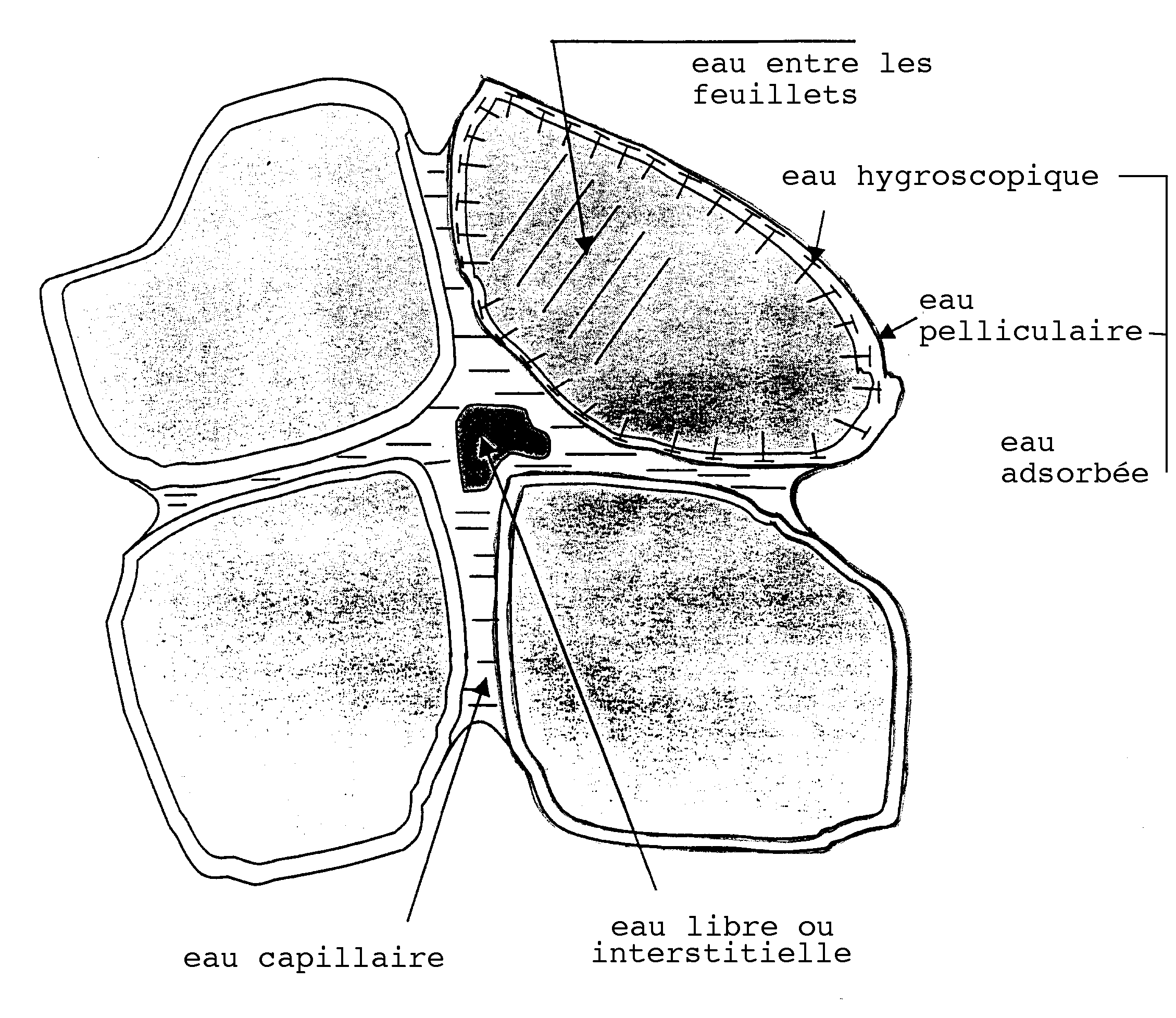
- Free (gravitational) water — flows under gravity through connected pores. It feeds the aquifers and can be captured by drainage or pumping.
- Capillary water — held in the fine pores by surface-tension forces, above the water table (capillary fringe).
- Adsorbed (bound) water — fixed to the surface of clay grains by electrostatic forces; it does not flow but strongly influences mechanical behaviour.
- Constitution water — chemically bound to the minerals, plays no part in geotechnical behaviour.
At the microscopic scale
Within the porous medium, water fills the spaces between the grains. Depending on pore size and applied pressure, it can be:
- Under positive pressure below the water table (free water)
- Under negative pressure (suction) above the water table, in the capillary fringe
Capillarity and suction
Capillarity is the ability of water to rise through the fine pores of the soil above the water table, under the effect of surface tension. The finer the pores, the greater the height of capillary rise.
| Soil type | Height of capillary rise |
|---|---|
| Coarse sand | a few cm |
| Fine sand | 20-50 cm |
| Silt | 1 to 3 m |
| Clay | up to 10 m and more |
After Hansbo.
Suction is the negative pressure exerted in capillary water or on adsorbed water. It is a key parameter for understanding:
- the shrink-swell of clay soils (wetting-drying cycles)
- the apparent cohesion of partially saturated soils
- capillary rise of water in buried concrete
Permeability
The permeability of a soil characterizes its ability to let water pass through it. In practical terms, it is the speed at which water can pass through a soil layer under a unit hydraulic gradient (for example 1 cm/s for a clean sand).
Darcy's law relates the flow rate Q to the permeability K:
Q = K · S · (ΔH / L)
- Q: flow rate (m³/s)
- K: coefficient of permeability (m/s)
- S: cross-section (m²)
- ΔH / L: hydraulic gradient (dimensionless)
Orders of magnitude
| Soil type | K (m/s) | Behaviour |
|---|---|---|
| Clean gravels | 10⁻¹ to 10⁻³ | Very permeable |
| Clean sands | 10⁻³ to 10⁻⁵ | Permeable |
| Silty sands | 10⁻⁵ to 10⁻⁷ | Slightly permeable |
| Silts, silty clays | 10⁻⁷ to 10⁻⁹ | Very slightly permeable |
| Compact clays | < 10⁻⁹ | Practically impervious |
Knowing the permeability is fundamental for sizing pumping and drainage systems, retaining structures below the water table, and for assessing the long-term behaviour of a structure in the presence of water.