
Water control in the service phase
In service, the structure must be durably protected against the action of water. Two complementary approaches:
- Active approach — act on the water table to reduce the loads on the structure (drainage)
- Passive approach — make the structure watertight to resist the loads (tanking)
The nature and quality of the devices depend on two factors: the intended use of the structure (car park, high-value rooms, archives, clean room…) and the nature of the surrounding materials.
1. Drainage
The more clayey the ground, the more drainage is needed.
The principle is to collect the water that would accumulate in contact with the structure and direct it towards an outlet (network, infiltration). The hydrostatic pressure on the buried walls is thereby removed.
Drainage of earth-retaining walls
The drainage to be implemented depends on the formwork system and the nature of the wall:
- Double-face formed wall — classic toe drainage with a draining geotextile, draining complex or dimpled membrane.
- Single-face earth-retaining wall / shotcrete — more delicate drainage, often integrated into the waterproofing complex.
Typical composition of a peripheral drainage:
- Reinforced-concrete wall with weep holes or screened drains at the toe
- Vertical draining layer (gravel, cellular complex, geocomposite)
- Filtering geotextile separating the drainage from the downstream backfill (anti-clogging)
- Selected backfill
- Toe drain at the foot of the wall, sloping towards an outlet manhole
- Gravity evacuation towards a sump or a network
2. Tanking
Tanking is a waterproofing system that makes the buried structure impervious to water. Several types, codified by the NF P 11-221 standard:
Type A — Structures of relatively watertight construction
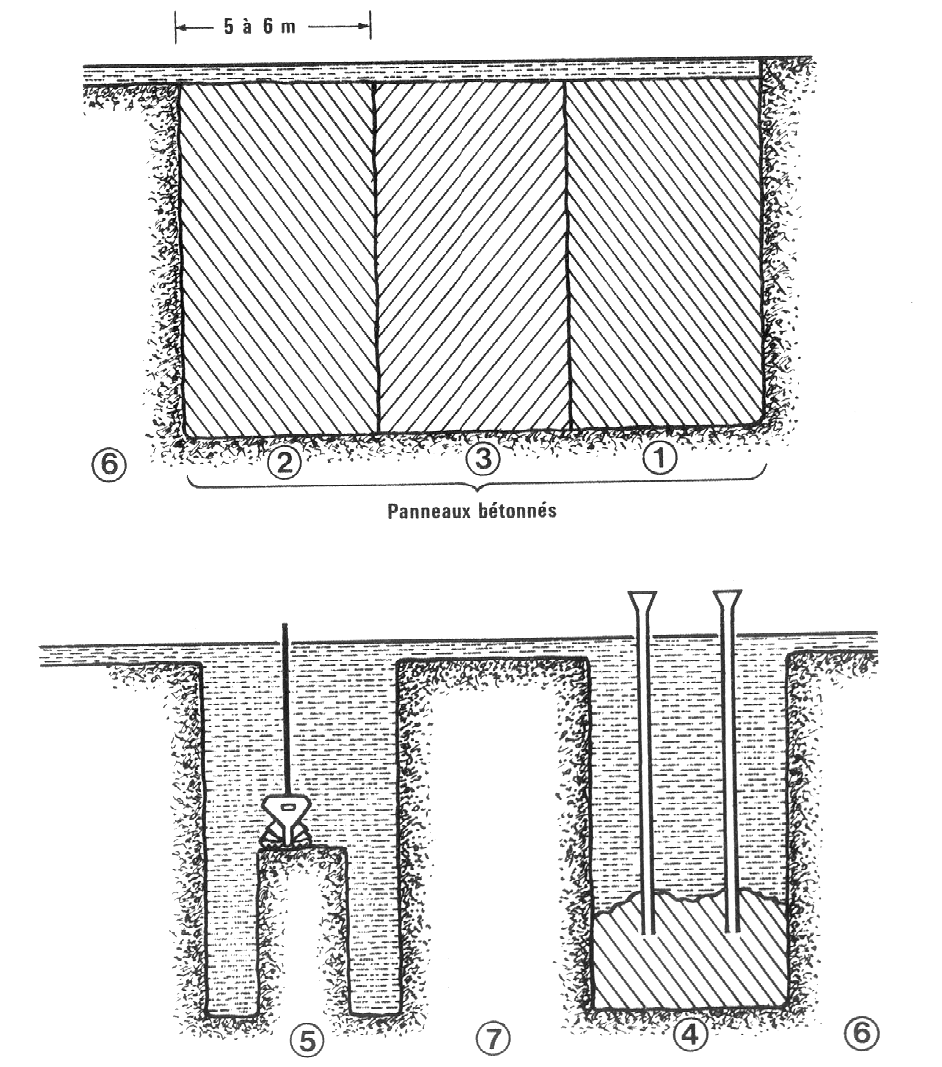
Watertightness is provided by the compactness and strength of the concrete itself. This is typically the case of diaphragm walls: it is the concrete, through its compactness, that opposes the passage of water. A slight passage of water is accepted (annual average < 1 L/day/m²) at a controlled and possibly recovered flow.
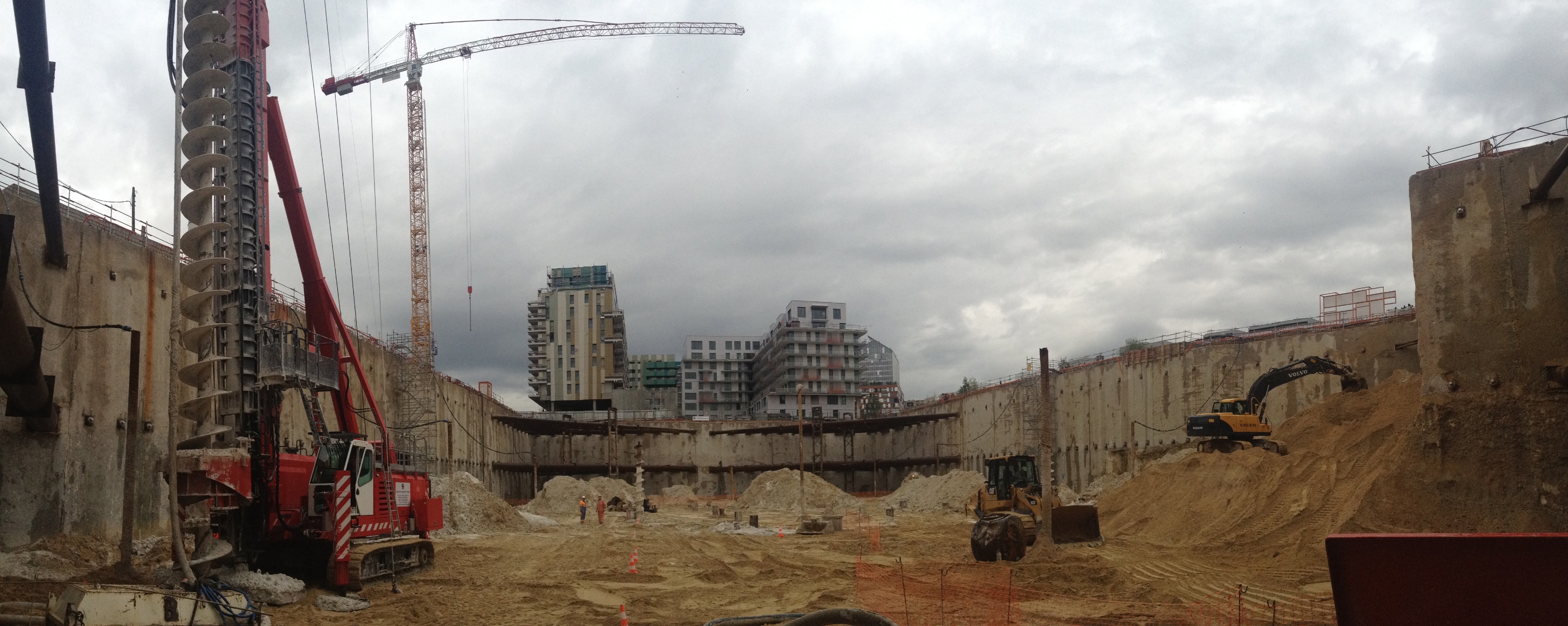
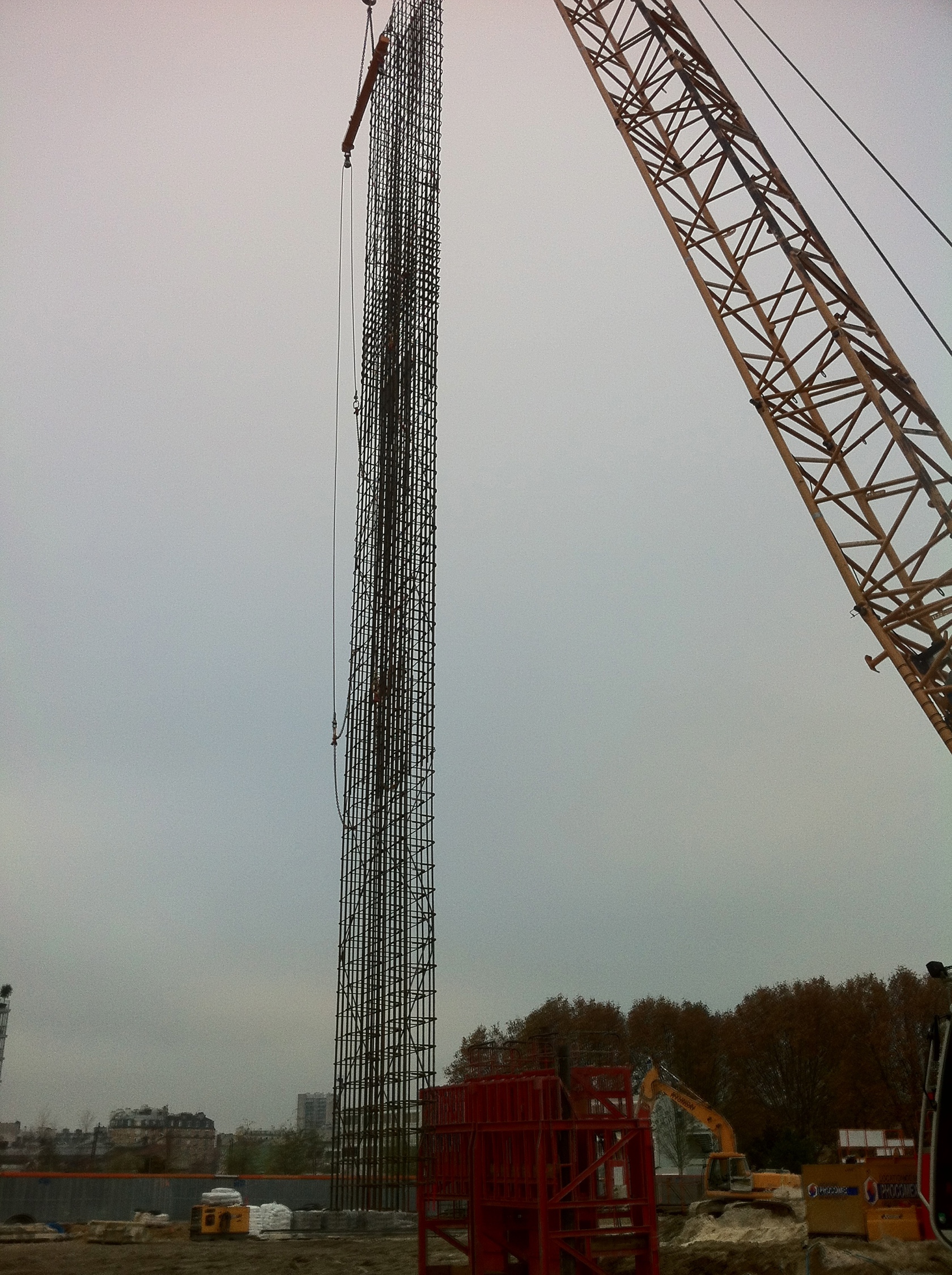
The main defects to watch for in a diaphragm wall:
- Poor cover of the reinforcement
- Defective joints between panels
- Insufficient depth (lack of embedment)
- Bulging (laitance, soil collapse)
- Verticality defect
Type B — Structures waterproofed by an internal coating (intrados)
A coating is applied to the inner face of the wall (room side). Two families:
Damp-proofing — a product based on mortar, resin or crystallization is applied to the concrete substrate. It does not let liquid water through, but does not prevent the diffusion of water vapour. Acceptable for car-park-type rooms. For high-value rooms, a ventilated double wall must be provided.
Crystallization is an impregnation system: a cement slurry containing an admixture modifies the structure of the concrete and makes it watertight over a few cm of depth.
Limitations of traditional intrados tanking:
- Do not resist cracking of the substrate
- Are permeable to water vapour (crystallization)
- Can only be implemented on structures calculated to receive them, which makes them unsuitable for many refurbishment projects
Waterproofing — a coating made of a plastic, elasto-plastic or elastic membrane. Stops both liquid water and water vapour. Much more effective but more costly.
Type C — Structures waterproofed by an external coating (extrados)
The waterproofing coating is applied on the outside of the load-bearing structure, upstream of the water thrust. It is the reference solution in new construction when access to the backfill is possible. The membrane (bituminous membrane, PVC or EPDM geomembrane, asphalt) is protected by a draining layer before backfilling.
The case of disorders during construction
During damp-proofing work, surface preparation by shot-blasting sometimes reveals significant cracking of the suspended slab, or cracks appear after crystallization. Several technical solutions exist, including the TECTOPROOF solution (Case A technical assessment issued by the CSTB) which makes it possible to achieve watertight intrados tanking: locating and opening the cracks, injection and sealing, removal of the tanking, implementation of the Tectoproof CA process, then a quartz-based finishing coating that provides mechanical protection and a decorative finish.